

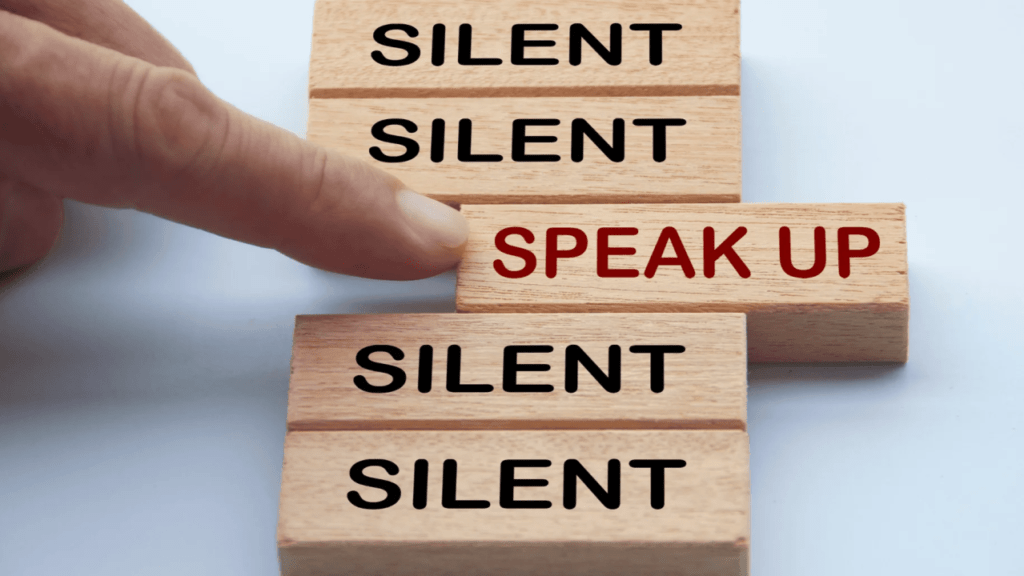
There’s a story about former Soviet Premier Nikita Khrushchev’ which will help make a point about the importance of ‘speaking up’. The year was 1956. Khrushchev was making a speech at the 20th Party Congress in Moscow. During this speech Khrushchev was listing the many atrocities committed under the reign of Joseph Stalin. Years before, Khrushchev worked for Stalin. During Stalin’s Great Purge (1937-38) Khrushchev was Head of the Moscow Communist Party and carried out the orders to arrest and execute thousands.
During the speech a heckler from the back yelled out: Hey Khrushchev: What were you doing all that time? You were a colleague of Stalin’s—why didn’t you stop him then? Khrushchev’s face turned red. He couldn’t see who asked the question, so he barked out: Who said that? Stand up! Nobody moved. Everyone looked down at their shoes. They were terrified. Again, Khrushchev shouted: I said who asked that question? The room remained silent. Khrushchev then said: I’ll tell you what I was doing. I was doing what you are doing, right now.
What you are doing, right now was of course ‘being silent’.
History tells us Khrushchev was embarrassed and ashamed that he had willingly carried out Stalin’s orders to do lots of bad things. He deeply regretted what he had done. His complicity ate away at him in his later years. At that speech, following the heckler’s question, he was imploring his countrymen not to do the same thing. Not to be silent. Not to be afraid to speak up.
Okay, so you know where this is going.
While our work may not present matters of life and death, it does present matters of right and wrong. Or, for certain, our work presents to us both good and bad decisions coming from above. What do we do when we think the direction being given is wrong? What do we do when we feel a wrong decision is about to be made?
Depending on what type of boss you have, it may be no big deal to speak up. Or, for those with bosses known to have some insecurity, or power and control issues, or those that demand so called ‘loyalty’, it no doubt is difficult to speak up. But it has to be done.
Organizations rise and fall based on the decisions they make. Culture can be harmed by a series of bad decisions that impact results, or decisions that run counter to the organization’s values. Voicing opposition to ideas or a direction about to be taken can keep an organization from experiencing a nosedive. And speaking up should become routine.
Healthy organizations thrive on dissent, opposing points of view, candor. Heck, even marriages are stronger when there is some dissent. Years ago, a psychologist named John Gottman noticed something odd about happy marriages: thriving couples often argue and disagree more than unhappy ones.
My suggestion is to start with the small stuff. Example: challenging an idea that comes up in a routine staff meeting.
So, the message thus far has been that each of us has the ‘duty’ to speak up. But it takes two to tango. Let’s wrap up with a message for the bosses on the receiving end of opposition.
Need it be said it’s critical that we create an environment where the team is encouraged to speak their mind? As the boss, you might tell your team that you may not always agree with their dissent, and that from time to time you may trump their point of view, but overall, you welcome their feedback – and opposition.
The greatest compliment your team can pay you is to disagree with you in front others. Because that signals to everyone that you as the boss are self-confident and can handle opposition. It signals that you understand what’s right for the organization. It signals that you understand there’s an obligation you have as the leader to encourage candor and listen to pushback with an open mind. And it signals that you are a seasoned leader.
Amen.
#leadership #leadership speaker